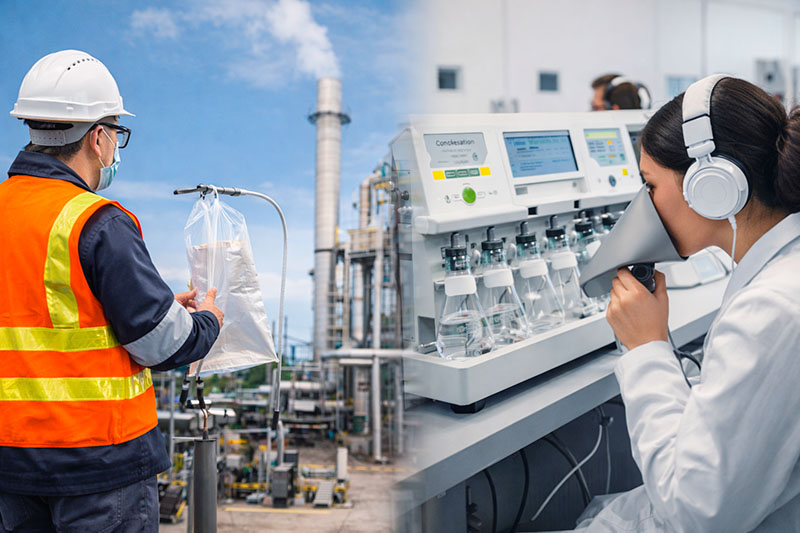
Why efficiency olfactometry matters
In environmental consulting, odor is not a subjective complaint: it is a measurable environmental parameter. Efficiency olfactometry tests are essential to evaluate the performance of deodorization systems (such as scrubber towers) and to demonstrate regulatory compliance, operational efficiency, and environmental responsibility.
This article explains how odor samples are taken, analyzed, and interpreted under the European reference framework, with a focus on technical rigor, traceability, and data reliability.
Regulatory and accreditation framework
Odor concentration analyses are carried out by dynamic olfactometry in accordance with:
- UNE-EN 13725:2004
Air quality : Determination of odor concentration by dynamic olfactometry - UNE-EN ISO/IEC 17025:2017
General requirements for the competence of testing laboratories
All analyses must be performed by a laboratory accredited by ENAC, ensuring:
- Technical competence
- Validated methodologies
- Full traceability and controlled uncertainty
In the case described, analyses are conducted under ENAC accreditation nº 1046/LE2024, which is a critical guarantee of data reliability.
Odor sampling: technical requirements and best practice
Correct sampling is non-negotiable. Poor sampling invalidates even the most accurate laboratory analysis.
Sampling location
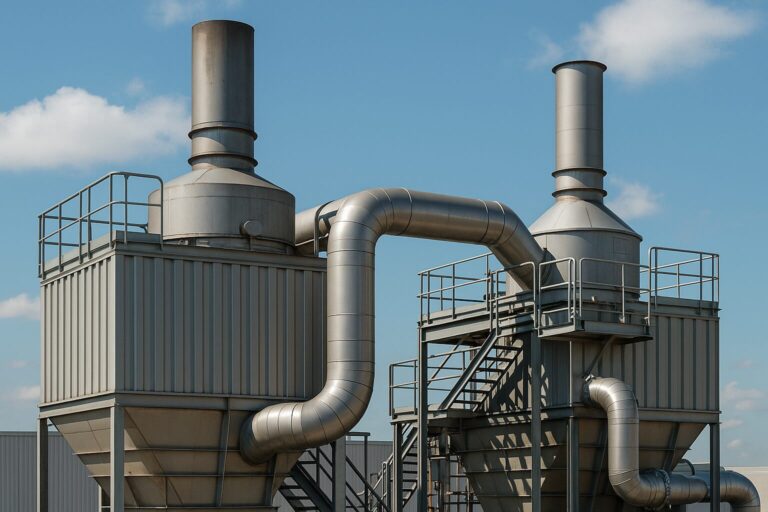
Samples are taken at the inlet of the deodorization system, i.e. before the scrubber tower, to assess treatment efficiency by comparison with outlet measurements (when applicable).
Sampling bags and materials
All samples are collected in Nalophan bags, specifically designed for olfactometric analysis:
- Capacities: 10 L, 25 L, or 55 L
- Material: Nalophan (polyethylene terephthalate)
– Odorless
– Chemically inert - Inlet tube: 8 mm PTFE (polytetrafluoroethylene)
- All materials classified as suitable under UNE-EN 13725:2004
These specifications are not optional: they are required to avoid contamination, adsorption, or odor loss.
Filling, transport, and storage conditions
Bag filling
Sample bags must not be filled to 100%.
- Recommended filling volume: 80: 90%
- Reason: pressure changes during transport (especially air transport) can compromise sample integrity
Transport and storage
To maintain representativeness:
- Temperature:
- Below 25 °C
- Above the sample dew point
- Below 25 °C
- Storage:
- In opaque containers
- Protected from light exposure
- In opaque containers
- Timing:
- Samples should ideally arrive at the laboratory on the same day
- Maximum allowed time between sampling and analysis: 30 hours (EN 13725 requirement)
- Samples should ideally arrive at the laboratory on the same day
Failure to meet these conditions introduces systematic bias and may invalidate results.
Laboratory analysis by dynamic olfactometry
All odor samples are analyzed by an independent ENAC-accredited laboratory under ISO 17025, using dynamic olfactometry as defined in UNE-EN 13725:2004.
Key output
- Odor concentration, expressed in odor units per cubic meter (ouE/m³)
Measurement uncertainty
Interpretation of results must explicitly consider:
- The uncertainty ranges defined in EN 13725, particularly Appendix G
Ignoring uncertainty is a common (and serious) analytical error
Complementary analyses (when applicable)
Depending on project scope and regulatory requirements, the odor study may be complemented with:
Pollutant concentration analyses
- Dräger colorimetric tubes (field measurements)
- Laboratory-based chemical analyses
VOC concentration analyses
- MiniRae 3000 analyzer (real-time screening)
- Laboratory VOC analyses
TOC (Total Organic Carbon)
Laboratory determination of TOC concentration, critical for understanding odor precursors and treatment efficiency
Final report: structure and deliverables
The final technical report consolidates all validated results and includes, at minimum:
- Odor concentration results (ouE/m³)
- Pollutant concentration results, if applicable:
- Dräger tube measurements
- Laboratory analyses
- Dräger tube measurements
- VOC concentration results, if applicable:
- MiniRae 3000 data
- Laboratory analyses
- MiniRae 3000 data
- TOC concentration results from laboratory testing
A robust report does not merely list values; it ensures:
- Traceability
- Compliance with standards
- Transparent uncertainty treatment
- Technical defensibility in regulatory or legal contexts
Bottom line
Efficiency olfactometry tests are only as good as:
- Sampling discipline
- Accredited laboratory analysis
- Correct interpretation of uncertainty
Cut corners in any of these steps and the data loses technical and regulatory value. When executed correctly, however, dynamic olfactometry provides objective, defensible evidence of odor impact and deodorization system performance; exactly what regulators, operators, and communities require.