Ethylene oxide remains one of the most critical sterilization agents in the medical device
industry. Its unique capability to sterilize heat- and moisture-sensitive instruments has secured
its position in modern healthcare manufacturing. Yet from an environmental and safety
engineering perspective, ethylene oxide represents a complex and unforgiving contaminant.
Toxic at very low concentrations and flammable within defined limits, it demands a control
strategy that goes far beyond conventional ventilation or dilution approaches.
The final stage of the sterilization cycle, air purification, is therefore not merely an auxiliary
system. It is the decisive safety barrier between an industrial process and the surrounding
environment.
The Emission Problem in Context
During sterilization, degassing, and post-conditioning phases, ethylene oxide is released in
highly variable concentration profiles. Vacuum pump exhaust streams may carry high, short-
duration peaks, while aeration cells generate lower but continuous emissions. These
fluctuations introduce instability into any downstream treatment technology.
Direct catalytic oxidation without buffering exposes the system to thermal shocks, incomplete
conversion, or operation near the lower explosion limit (LEL). From a process safety standpoint,
such variability is unacceptable. A stable inlet concentration profile is essential if high
destruction efficiencies and regulatory compliance are to be guaranteed.
Current regulatory expectations are uncompromising. Destruction efficiencies above 99 percent
and outlet concentrations below 1 ppm are required in the United States. European frameworks
such as TA-Luft impose even stricter concentration limits, down to 0.5 mg/Nm³. These values
effectively eliminate the feasibility of simple absorption-only systems or uncontrolled thermal
oxidation without advanced process control.
Two-Stage Engineering Approach
A technically robust configuration for ethylene oxide abatement is based on a two-stage
architecture combining hydraulic equalization and catalytic oxidation
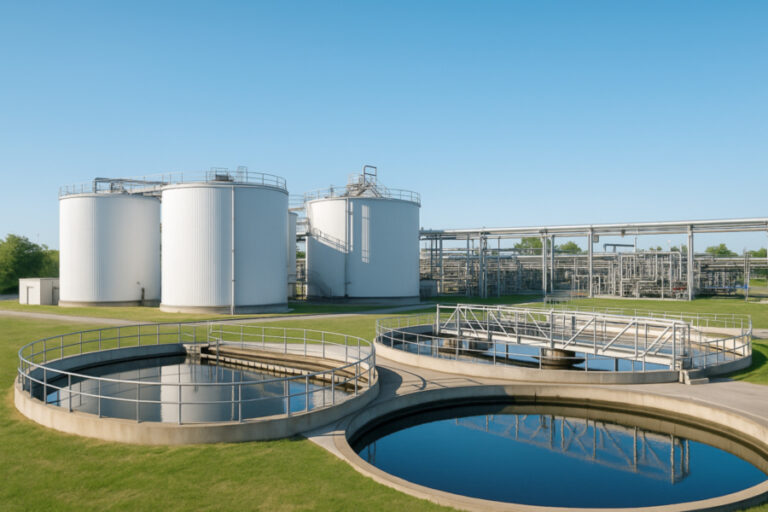
The first stage functions as a concentration balancer. A recirculating water system distributes
liquid over a column, creating dynamic absorption and desorption conditions. When inlet
ethylene oxide concentrations rise, the gas is partially absorbed into the circulating water. When
concentrations fall, previously absorbed EtO is stripped and reintroduced into the gas stream.
The result is not removal at this stage, but stabilization.
This hydraulic buffering mechanism performs a critical process function: it transforms a highly
transient emission profile into a controlled and predictable feed stream for the oxidation reactor.
For chemical engineers, the value of this step lies in the reduction of peak loading, mitigation of
LEL excursions, and stabilization of reactor temperature control. The catalyst is no longer
exposed to extreme concentration swings, allowing for optimized residence time and bed sizing.
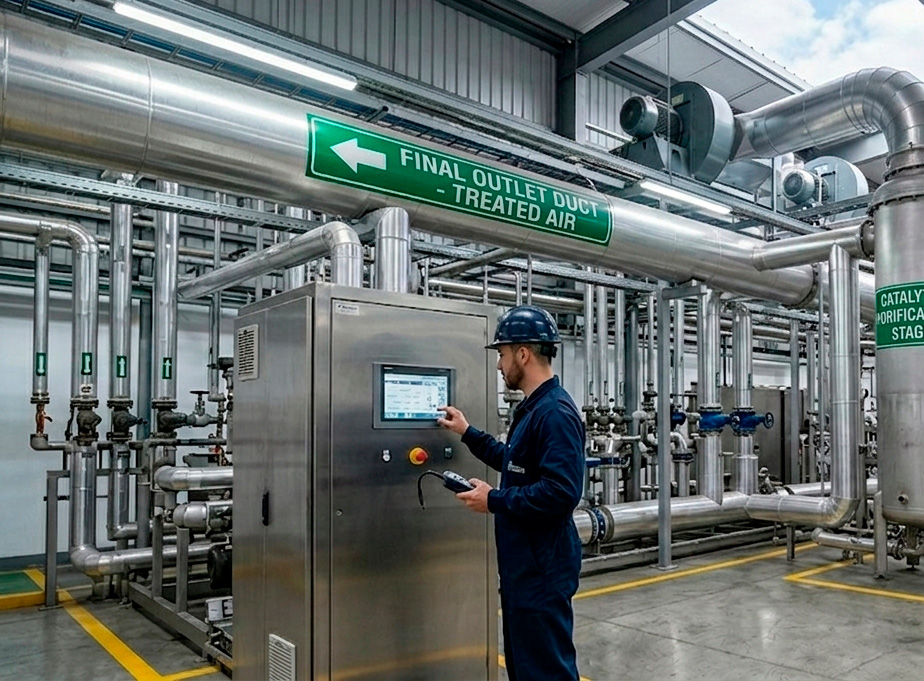
The second stage consists of catalytic oxidation. Under controlled temperature conditions,
ethylene oxide is converted to carbon dioxide and water. The reaction is exothermic, and an
integrated heat exchanger captures part of this energy to reduce auxiliary fuel demand.
Preheating of the inlet stream, typically via a gas-fired heater, ensures that the catalyst operates
within its optimal temperature window, although electric or steam-based heating can be
employed depending on site utilities.
The catalytic system is suitable provided that the gas stream contains only compounds
composed of carbon, hydrogen, nitrogen, and oxygen, and does not include catalyst poisons.
Within these boundaries, oxidation efficiency above 99 percent is achievable. For facilities
operating under tight environmental constraints, this level of performance is essential.
Elimination of Secondary Waste
An important engineering distinction of catalytic abatement compared to certain chemical
scrubbing systems is the absence of secondary liquid waste streams. Traditional sulfuric acid-
based absorption systems may generate contaminated glycol or other residual effluents that
require further treatment or disposal. By contrast, catalytic oxidation converts the contaminant
directly to stable gaseous end products without introducing additional reagents.
For SHE departments, this significantly simplifies compliance and reduces chemical handling
risk. For operations management, it removes a recurring waste management cost and potential
liability.
Pressure Control and Containment Philosophy
From a safety engineering perspective, maintaining negative pressure throughout the plant is
fundamental. By positioning the extraction fan downstream of the catalytic reactor, the entire
system operates under slight vacuum conditions. This configuration prevents fugitive emissions
and reduces the probability of ethylene oxide escaping into occupied areas.
Integrated LEL monitoring and automated temperature control form part of the protective layers
required for safe operation. In sterilization facilities where operators, maintenance staff, and
potentially sensitive products coexist, the reliability of these control layers cannot be overstated.
Pressure Control and Containment Philosophy
From a safety engineering perspective, maintaining negative pressure throughout the plant is
fundamental. By positioning the extraction fan downstream of the catalytic reactor, the entire
system operates under slight vacuum conditions. This configuration prevents fugitive emissions
and reduces the probability of ethylene oxide escaping into occupied areas.
Integrated LEL monitoring and automated temperature control form part of the protective layers
required for safe operation. In sterilization facilities where operators, maintenance staff, and
potentially sensitive products coexist, the reliability of these control layers cannot be overstated.
Integration with the Sterilization Workflow
Ethylene oxide abatement cannot be treated as an isolated utility. It must be engineered as an
integrated extension of the sterilization process itself. Preconditioning, sterilization, vacuum
degassing, quarantine aeration, and final air purification form a continuous operational chain.
The abatement system must accommodate emissions from each phase without interruption.
Particularly during vacuum degassing, concentration peaks demand rapid response and thermal
stability. During extended aeration phases, the system must maintain high efficiency at lower
but persistent loads. Designing for both extremes is an exercise in dynamic process engineering
rather than static equipment sizing.
Engineering Evaluation Criteria
Before implementing catalytic abatement, a facility should conduct a detailed evaluation that
includes mass balance analysis, concentration variability mapping, and hazard identification
studies. The presence of catalyst poisons, variability of production cycles, and fuel availability
for preheating all influence feasibility and operating cost.
Energy integration potential should also be assessed. Because the oxidation reaction is
exothermic, steady-state operation may significantly reduce auxiliary fuel demand once the
system reaches thermal equilibrium.
Conclusion
Ethylene oxide sterilization will remain indispensable for advanced medical device
manufacturing. However, its environmental and occupational risk profile demands a highly
engineered abatement strategy. A two-stage system combining hydraulic concentration
balancing and catalytic oxidation provides a technically robust solution capable of meeting
stringent emission limits while avoiding secondary waste generation.
For Industrial Safety professionals, the key lesson is clear: effective ethylene oxide control is not
simply about destruction efficiency. It is about process stabilization, thermal management,
containment philosophy, and integration with upstream sterilization dynamics. Only when these
elements are addressed as a coherent system can safe, compliant, and sustainable operation
be achieved.