Home / Technologies / Water and discharge / Biological treatment

BiologicalWater and discharge

Biological treatment

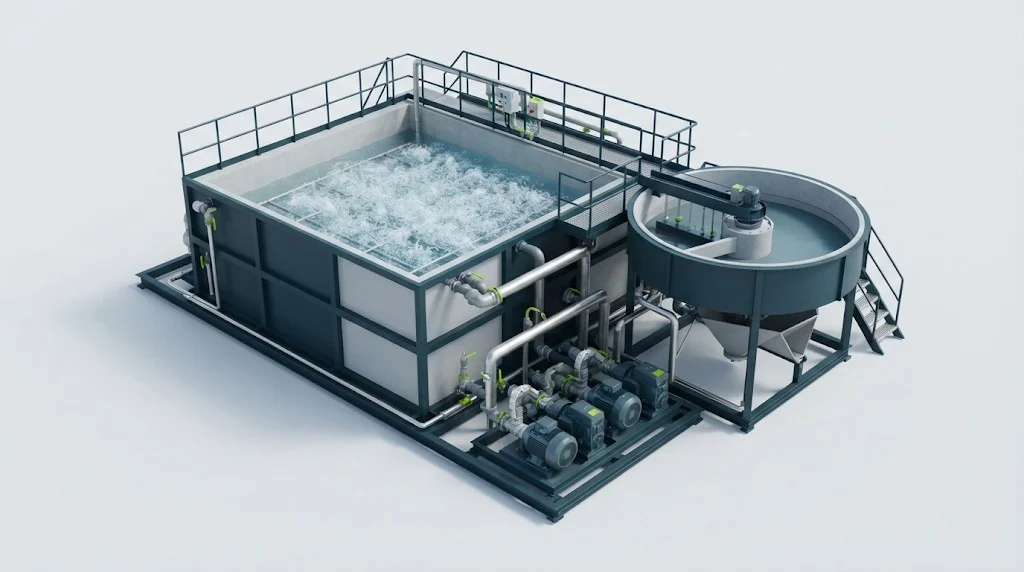
Aerobic or anaerobic reactors in which microorganisms reduce COD and BOD and separate suspended solids, oils and fats. Anaerobic systems produce little sludge and generate biogas.

Other technologies
Biological treatment – plant diagram

Systems

Aerobic and anaerobic

Pollutants

COD, BOD, suspended solids, fats

By-product (anaerobic)

Biogas

Flow rate

Activated sludge 0.5–500 m³/h; MBR 15–1,000 m³/day; fixed bed 1–15 m³/h

Operating principle

How it works

  1. 01

    Pretreatment

    Separation of suspended solids, oils and fats.

  2. 02

    Biological reactor

    Microorganisms break down organic matter, with or without oxygen.

  3. 03

    Separation

    A clarifier or ultrafiltration membranes separate the sludge from the water.

  4. 04

    Polishing

    Optional tertiary treatment to reuse the water.

Specifications

Technical data

Activated sludgeAerobic, continuous, biomass in flocs; where space is available
Sequencing batch reactor (SBR)Aerobic, in cycles, in a single tank; small and highly variable volumes
Membrane bioreactor (MBR)Activated sludge with internal ultrafiltration, no clarifier; little space
Moving bed (MBBR)Biofilm on moving carriers; little space
Fixed bed with granular ligniteAdsorbs, supports the biofilm and dampens peaks; difficult compounds and color
Rotating biological contactors and trickling filtersBiomass attached to rotating discs or a gravel bed
Upflow anaerobic sludge blanket reactor (UASB)High organic loads; very low operating cost
High-rate anaerobicFor very high organic loads
Flow rateActivated sludge 0.5–500 m³/h; MBR 15–1,000 m³/day in a compact unit; fixed bed 1–15 m³/h
Activated sludge: designVolumetric loading 0.5–1.2 kg COD/m³·d; sludge age 5–15 days; dissolved oxygen 1–2 mg/l
Oxygen demand0.9–1.3 kg O₂ per kg of BOD removed; around 4.6 g O₂ per g of ammonium nitrified
NutrientsBOD:N:P ratio of 100:5:1
MBBR: designCarriers in 50–70% of the volume, 500–1,200 m² of surface per m³; retention time 3–6 h; 0.2–0.5 kg of sludge per kg of COD
Anaerobic: whenFrom around 3,000 mg/l of COD; produces biogas
UASBLoading 5–10 kg COD/m³·d, retention 6–12 h, upflow velocity 0.5–1 m/h
EGSB (high rate)Loading 10–25 kg COD/m³·d, retention 2–6 h, upflow velocity 3–10 m/h
Nitrogen removalAerobic nitrification (oxygen > 2 mg/l, sludge age > 10 days) and anoxic denitrification (oxygen < 0.5 mg/l) with a carbon source
AnammoxRemoves ammonium with no external carbon, with 60% less aeration and 90% less sludge; slow start-up of 3–6 months
Power consumptionMBBR and SBR 0.3–0.8 kWh/m³; nitrification and denitrification 0.6–1.8 kWh/m³; anaerobic and Anammox 0.2–0.5 kWh/m³
Indicative footprintMBBR 2–4 m² per m³/h; SBR 4–8 m² per m³/h

Advantages

  • The cheapest method for biodegradable pollutants
  • Simple, automated operation
  • The water can be reused after tertiary treatment
  • Intensive systems for large flow rates in a small footprint
  • The anaerobic process keeps sludge to a minimum and produces biogas

Field of application

  • Municipal wastewater and small communities
  • Food industry, textiles, farms and slaughterhouses

Limitations

  • Only suitable for biodegradable pollutants
  • Biocides or inhibiting substances block the process

Industries

Where it is used

Municipal wastewaterFoodTextilesFarmsSlaughterhouses

Datasheet

Full datasheet: Biological treatment

Dimensions, design data and operating ranges. Leave us your details and an engineer will send you the datasheet and tell you whether this technology fits your plant.

All technologies

Datasheet

Request the full datasheet

Choose the technology and leave us your details. An engineer who knows that technology will send you the datasheet.

  • Full technical data for the technology you choose
  • An assessment of whether it suits your gas or your effluent

Would you rather write to us directly?

info@wizzum.com

The first conversation is free and with no obligation.