Home / Technologies / Water and discharge / DAF flotation

SeparatesWater and discharge

Dissolved air flotation (DAF)

Separates suspended solids, oils and fats by bringing them to the surface. Part of the treated water is saturated with air under pressure; when it is depressurized in the tank, microbubbles form that attach to the flocs and lift them, and a scraper removes the floated sludge.

Other technologies
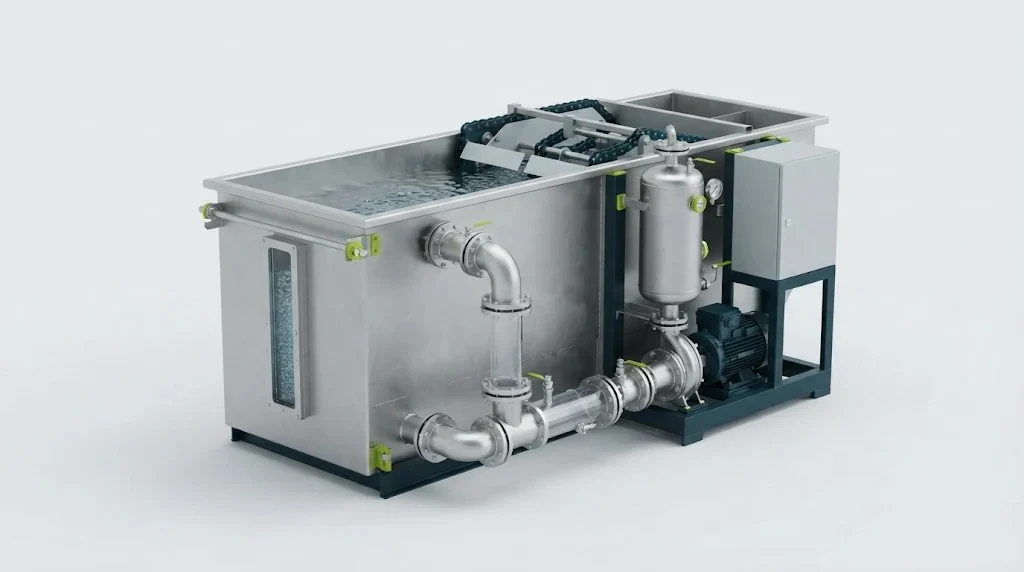
Dissolved air flotation (DAF) – plant diagram

Flow rate

5–4,000 m³/h

Pollutants

Suspended solids, oils, fats, COD

Solids loading

Up to 40 kg DS/m²

Execution

Compact, lamella or in a reinforced concrete tank

Operating principle

How it works

  1. 01

    Coagulation and flocculation

    The coagulant and flocculant are dosed in a pipe flocculator or, when more contact time is needed, in flocculation chambers.

  2. 02

    Saturation

    Part of the treated water returns to the saturator, where air is dissolved under pressure.

  3. 03

    Flotation

    When the pressure is released, the microbubbles attach to the flocs and lift them; the lamella modules slow the water down and improve separation.

  4. 04

    Float removal

    A surface scraper pushes the floated sludge into the collection trough.

  5. 05

    Outlet

    The treated water leaves at the bottom and the sediments are purged from the base.

Specifications

Technical data

Flow range5–4,000 m³/h
Low profile and large surface area5–200 m³/h; medium and high solids and fat loads. The large surface area helps the float build up and raises the dry solids of the sludge to as much as 4%
High profile with internal lamella modules5–250 m³/h; low and medium loads, small footprint
Crossflow and countercurrent lamella plates400–1,200 m³/h; all types of loads
Reinforced concrete tanks1,000–4,000 m³/h, with or without lamella packs, which reduce footprint and volume
MaterialsAISI stainless steel or polypropylene up to 250 m³/h; above that, coated carbon steel. Options in super duplex, engineering plastics and marine-grade coatings for aggressive water
PollutantsSuspended solids, oils and fats, particulate BOD and COD, algae and total carbon in seawater, nutrients, detergents and precipitated metals
Compact buildUp to 15 m³/h, everything on one skid: DAF unit, electrical panel and coagulation-flocculation. Above that, the DAF unit is separate and the skid carries the panel and the flocculation
TestingFactory acceptance tests (FAT) before shipping; commissioning in hours instead of weeks
Standard materialAISI 304 stainless steel; AISI 316 on request
Floated sludgeDry solids 3–4 times higher than in a conventional DAF in the large-surface version, thanks to a scraper that moves against the flow
SedimentsA shaftless screw collects heavy solids from the bottom and discharges them through a pneumatic valve; each discharge cleans the walls
ComponentsSludge trough, air diffuser, chain and flights, bottom screw, level meter, saturation manifold and valves, sludge level sensor, pneumatic cabinet, safety valve, sampling point and air injection
Typical efficiencyBOD₅ and COD 50–75%; suspended solids and turbidity 85–95%; total phosphorus 60–90%; total nitrogen 30–50%; oils and fats 80–95%
Typical design parametersSaturation pressure 4–6 bar; pressurized recycle of 10–30% of the flow; 30–70 µm microbubbles (indicative values)
Surface hydraulic loading5–15 m³/m²·h
Air-to-solids ratio0,02–0,06
Power consumption0.2–0.6 kWh/m³ of treated water, mainly for air saturation
Indicative footprint2–4 m² per m³/h of flow
Saturator life10–15 years; stainless steel is preferable

Available sizes · low-profile, large-surface unit

Flow rate (m³/h)Dimensions L × W × H (mm)Effective area (m²)Empty weight (kg)Operating weight (kg)Recirculation pump (kW)Flights (units)
32,300 × 1,625 × 1,4001,245012505,53
52,300 × 1,900 × 1,4001,551015005,53
103,150 × 2,000 × 1,5002,4120032005,53
154,000 × 2,200 × 1,5004,2150045005,55
205,000 × 2,200 × 2,3006,6210010 1007,56
306,500 × 2,200 × 2,30010240013 4007,58
407,000 × 2,200 × 2,30011250014 5007,59
508,000 × 2,200 × 2,30013270016 7001110
609,000 × 2,200 × 2,30015290018 4001112
8011,000 × 2,200 × 2,30019400024 1001115
1009,500 × 3,400 × 2,30024460029 3001513
12011,000 × 3,400 × 2,30028475034 2501515
14012,500 × 3,400 × 2,30032,5520039 2001518
16014,000 × 3,400 × 2,30036560044 2501520
20017,000 × 3,400 × 2,30046620053 2001525

Advantages

  • Separates in a few minutes what a clarifier takes hours to separate
  • Smaller footprint than sedimentation
  • More concentrated sludge, easier to dewater
  • Very effective with fats and light flocs
  • Compact plug-and-play version

Field of application

  • Pretreatment ahead of the biological stage or an MBR
  • Fat separation in the food industry
  • Seawater pretreatment in desalination
  • Aggressive, acidic or alkaline wastewater

Limitations

  • Reagents have to be dosed
  • Produces floated sludge that has to be managed
  • Uses energy to saturate the air

Industries

Where it is used

Food and beverageSlaughterhouses and meat processingDairiesChemicalsPaper millsPetrochemicalsTextilesDesalination

Datasheet

Full datasheet: DAF flotation

Dimensions, design data and operating ranges. Leave us your details and an engineer will send you the datasheet and tell you whether this technology fits your plant.

All technologies

Datasheet

Request the full datasheet

Choose the technology and leave us your details. An engineer who knows that technology will send you the datasheet.

  • Full technical data for the technology you choose
  • An assessment of whether it suits your gas or your effluent

Would you rather write to us directly?

info@wizzum.com

The first conversation is free and with no obligation.