Home / Technologies / Acid gases / Dry flue gas treatment

NeutralizesAcid gases

Dry flue gas treatment (bicarbonate and activated carbon)

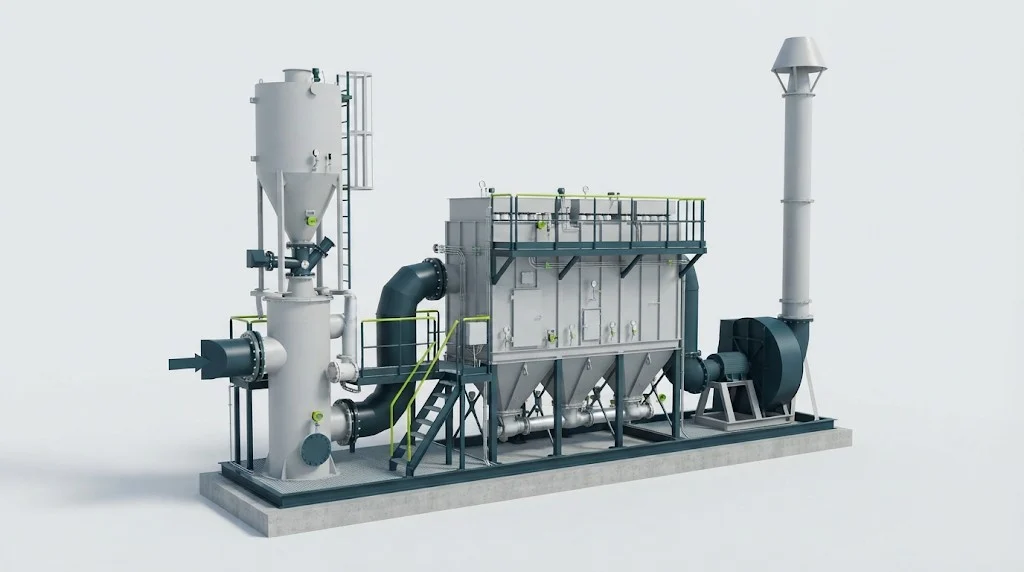
Milled sodium bicarbonate and powdered activated carbon are injected into the flue gas duct. The bicarbonate neutralizes HCl, SO₂ and HF, and the carbon adsorbs mercury and other trace pollutants. The bag filter captures the salts formed, the excess reagent and the dust, and neutralization is completed on the bags themselves.

Other technologies
Dry flue gas treatment (bicarbonate and activated carbon) – plant diagram

HCl and HF removal

Approx. 98%

SO₂ removal

Approx. 90%

Operating temperature

Around 200 °C

Water and wastewater

None produced

Operating principle

How it works

  1. 01

    Storage

    Each reagent arrives by pneumatic tanker at its own silo, with a vent filter and level control.

  2. 02

    Milling and dosing

    The bicarbonate is milled to increase its reactivity and dosed by weight; the activated carbon has its own line.

  3. 03

    Injection

    Pneumatic conveying carries each reagent to the lances in the flue gas duct.

  4. 04

    Mixing reactor

    A cyclone-type chamber creates a vortex that spreads the powder and ensures the contact time.

  5. 05

    Bag filter

    The reagent layer on the bags completes the reaction; the dry residue is discharged through the hoppers.

Specifications

Technical data

Operating principleDry reagent injection into the duct and filtration
Alkaline reagentSodium bicarbonate (NaHCO₃) milled on site
AdsorbentPowdered activated carbon, for mercury and other trace pollutants
PollutantsHCl, SO₂, HF, mercury and other volatile heavy metals
Reagent linesTwo independent lines: silo, screw extraction, intermediate hopper, gravimetric dosing, pneumatic conveying and lances
MillingReduces the bicarbonate grain size and increases its reactivity; for carbon, a deagglomerator if the grain size requires it
Mixing reactorCyclone-type chamber with separate inlets for each reagent, designed for gas velocity, residence time and pressure drop
Bag filterPart of the process: cleaning controlled by differential pressure to keep the reactive layer without exceeding the filter's limits
Reagent consumptionDepends on the acid concentration at the inlet, the emission limits and how the filter is run; carbon consumption depends on the amount and forms of mercury
ControlPLC with HMI screen; automatic dosing, silo level, mill and conveying monitoring, alarms and interlocks
SafetyFire and dust explosion protection on the carbon line, based on the risk assessment
ResidueDry solid (sodium salts, excess reagent, carbon and dust) handed over to an authorized waste manager

Reference case: 66,000 m³/h at 200 °C (around 38,100 Nm³/h)

PollutantInlet (mg/Nm³)Outlet (mg/Nm³)Removal
HCl4301097,7 %
SO₂4805089,6 %
HF44197,7 %

Advantages

  • Uses no water and produces no wastewater
  • Removes acid gases, mercury and dust at the same time
  • Works with the hot gas, with no cooling or reheating
  • Dosing matched to the load at each moment
  • Can be added ahead of an existing or new bag filter

Field of application

  • Waste and biomass incineration
  • Industrial and ceramic kilns
  • Boilers burning fuels that produce acid gases
  • Metalworking and foundries
  • Chemical processes with HCl, SO₂ or HF in the flue gas

Limitations

  • Produces a solid residue that has to be managed
  • Efficiency also depends on the design and operation of the bag filter
  • Reagent consumption rises with very strict SO₂ requirements
  • Needs fire and dust explosion protection on the carbon line

Industries

Where it is used

IncineratorsWaste-to-energyCeramicsMetalworkingChemicals

Datasheet

Full datasheet: Dry flue gas treatment

Dimensions, design data and operating ranges. Leave us your details and an engineer will send you the datasheet and tell you whether this technology fits your plant.

All technologies

Datasheet

Request the full datasheet

Choose the technology and leave us your details. An engineer who knows that technology will send you the datasheet.

  • Full technical data for the technology you choose
  • An assessment of whether it suits your gas or your effluent

Would you rather write to us directly?

info@wizzum.com

The first conversation is free and with no obligation.