Home / Technologies / VOCs and solvents / e-RTO

DestroysVOCs and solvents

Electric RTO (e-RTO)

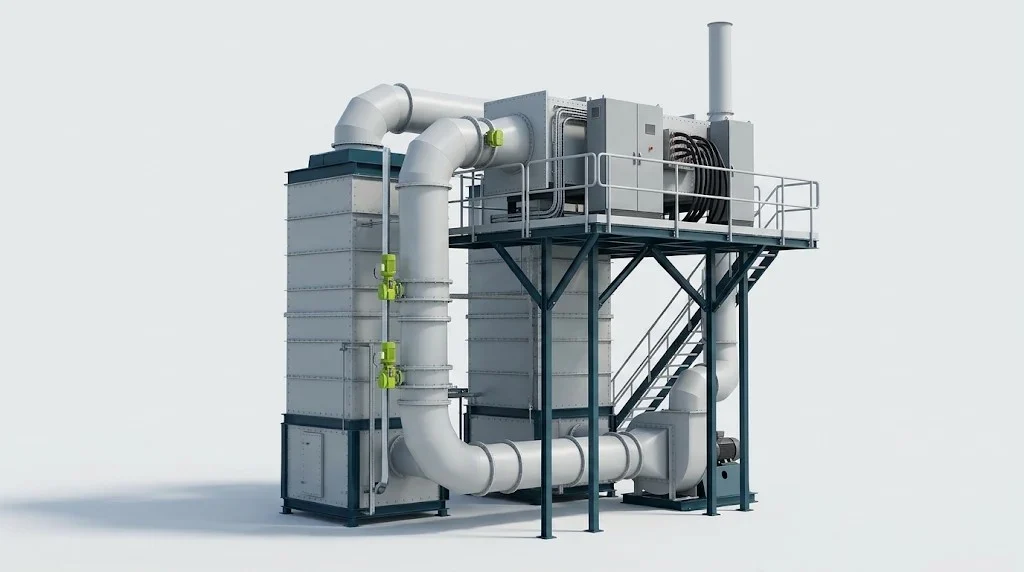
It works like an RTO, with ceramic bed towers and switching valves, but without a burner: the heat comes from electric heating elements in the oxidation chamber. With no flame there is no combustion NOx and, if the electricity is renewable, heating produces no CO₂. It is an electric incinerator: it works like an RTO, but without natural gas.

Other technologies
Electric RTO (e-RTO) – plant diagram

Removal efficiency

> 99 %

Heating

Electric, flameless

Temperature

850–1100 °C

Above the autothermal point

No heat input

Operating principle

How it works

  1. 01

    Start-up

    The heating elements run at full power until the chamber reaches oxidation temperature.

  2. 02

    Preheating

    The gas passes through the hot ceramic bed before entering the chamber.

  3. 03

    Oxidation

    The VOCs are oxidized to CO₂ and H₂O. When the concentration exceeds the autothermal point, the heating elements switch off.

  4. 04

    Modulation

    Below that point, thyristors control the power of the heating elements to hold the temperature.

  5. 05

    Flow reversal

    As in the RTO, the valves reverse the gas flow between the towers and the heat stays in the beds.

Specifications

Technical data

Operating principleRegenerative thermal oxidation with an electric heat source
Heat sourceElectric heating elements in the oxidation chamber, controlled by thyristors
Oxidation temperatureUsually around 850 °C; up to 1100 °C depending on the design
Removal efficiencyOver 99%, the same as a burner-fired RTO
Power consumptionDepends on the VOC concentration and calorific value; zero above the autothermal point
Heating emissionsNo combustion NOx; zero CO₂ with renewable power
VOC concentrationLow, medium or high
Air flow rate5,000–100,000 Nm³/h
Configurations2 or 3 towers, as in the RTO
To be checked at the plantElectrical power available for start-up and continuous operation

Advantages

  • No flame and no combustion NOx
  • Lower CO₂ emissions, and none with renewable power
  • Quieter, because there is no combustion air fan
  • Simpler installation and commissioning, with no gas connection
  • Minimal maintenance

Field of application

  • Plants that want to electrify VOC treatment
  • Sites without a gas connection or with NOx limits
  • VOCs at low, medium or high concentration
  • Odor reduction

Limitations

  • Needs enough electrical power, especially at start-up
  • At low VOC concentrations, power consumption is continuous
  • Does not treat dust or acid gases: a filter or a scrubber is needed

Industries

Where it is used

ChemicalsCoatingsFlexographic printingOdor reduction

Datasheet

Full datasheet: e-RTO

Dimensions, design data and operating ranges. Leave us your details and an engineer will send you the datasheet and tell you whether this technology fits your plant.

All technologies

Datasheet

Request the full datasheet

Choose the technology and leave us your details. An engineer who knows that technology will send you the datasheet.

  • Full technical data for the technology you choose
  • An assessment of whether it suits your gas or your effluent

Would you rather write to us directly?

info@wizzum.com

The first conversation is free and with no obligation.