Home / Technologies / Water and discharge / Filter press

DewatersWater and discharge

Filter press for sludge dewatering

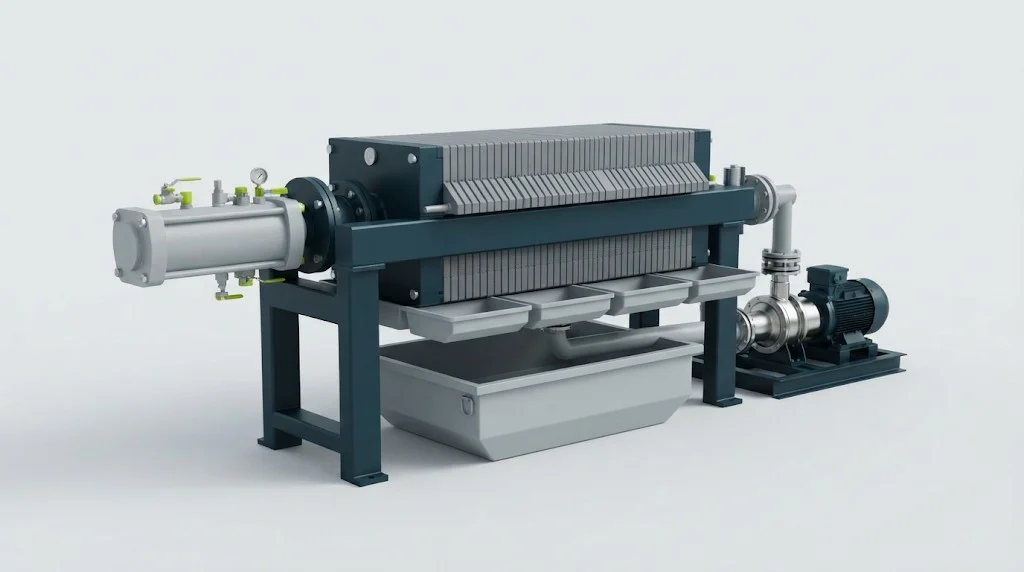
Separates solids from liquid under pressure. The sludge enters the chambers formed by plates with filter cloths: the water passes through the cloth as filtrate and the solids are pressed into cakes, which drop out when the filter opens. It greatly reduces sludge volume and lowers the cost of transporting and managing it.

Other technologies
Filter press for sludge dewatering – plant diagram

Plates

250–1,500 mm

Capacity

5–5,084 l of cake

Filtration pressure

6–16 bar

Cake dry solids

30–40% DS

Operating principle

How it works

  1. 01

    Closing

    A hydraulic cylinder presses the plate pack against the fixed head.

  2. 02

    Filling and filtration

    A pump drives the sludge into the chambers; the filtrate passes through the cloths and leaves through the plate channels.

  3. 03

    Pressing

    As the pressure rises, the solids compact into cakes; with membrane plates they are squeezed again, up to 16 bar, which gives 3–8% more dry solids.

  4. 04

    Washing and blowing (optional)

    Manifold for drying the cake with air or washing it countercurrent.

  5. 05

    Opening and discharge

    The plates are separated one by one, manually or automatically, and the cakes drop into a hopper or a container.

Specifications

Technical data

TypeSide-bar plate shifting
Cake dry solids30–40% DS. Membrane squeezing: +3–8%; air blowing: +1–3%
Feed sludge3–6% DS, well flocculated
Filtration pressure6–16 bar. Biological 6–8 · physico-chemical 7–10 · industrial 8–10 · mining up to 15. PN10 and PN16 units; PN25 on request
Cycle time60–120 min, depending on the sludge and cake thickness
Cake thickness25, 30, 40 or 50 mm
End of cycleWhen the design pressure is reached or when the filtrate flow falls to 5–10% of the initial flow
ConditioningPolyelectrolyte 2–10 kg/t DS; coagulants (FeCl₃, PAC, aluminum sulfate) or lime, depending on the sludge
Energy consumption5–15 kWh/t DS; feed pumping accounts for 50–70%
Service lifePlates and hydraulics 10–20 years; frame over 20; cloths 6 months to 2 years
AutomationManual; semi-automatic with electro-hydraulic closing; automatic with chain plate shifting, with shaker or with plate-by-plate carriage
Plate size250–1,500 mm
Plate configurationOpen or closed; center, top center, offset, corner or external feed
Operating temperatureFrom −10 to +120 °C
Plate materialHomopolymer or copolymer polypropylene, antistatic polymers, PVDF
MembranesPP, PVDF, PTFE; welded or replaceable
Filter clothsPP, PE, polyester, polyamide or Rilsan; multifilament, monofilament or staple fiber yarn; plain, twill, satin or basket weave
Cloth washingAutomatic washing frame with pressurized water (optional)
Frame materialsCarbon steel, AISI 304, AISI 316, polypropylene
ControlPLC with HMI touchscreen; switchgear and software brand chosen by the customer
OptionsCake drying or washing manifold, drip tray, chamber, membrane or mixed plate pack, wetted parts in stainless steel or PP, all-stainless version for food and pharmaceuticals, ATEX

Cake capacity (l) by size and number of plates

No. of plates5101520253035405060708090100
250×250591318——————————
470×47018406284106128150———————
630×630—72112153193233273313——————
800×800——192261329398466535672—————
1000×1000———429541654767880110513311556———
1200×1200————752908106512211535184821612474——
1300×1300——————1258144318132183255329233293—
1500×1500———————2003251630293543405645705084

Advantages

  • Cake with a high dry solids content
  • Large reduction in sludge volume and in the cost of managing it
  • Moderate energy use: 5–15 kWh/t DS
  • Long service life and simple operation
  • Filtrate reusable as process water, with no emissions to air
  • Suitable for industrial and municipal sludge

Field of application

  • Dewatering of sludge from wastewater treatment plants and physico-chemical treatment
  • Solid-liquid separation in industrial processes
  • Recovery of valuable solids or liquids
  • Removal of impurities from the product

Limitations

  • Works in cycles, not continuously
  • The sludge has to be conditioned with flocculant
  • The cloths have to be washed and replaced periodically
  • Higher initial investment than other dewatering systems

Industries

Where it is used

Municipal wastewater treatment plantsChemicalsMining and aggregatesCeramicsElectroplatingFoodPharmaceuticals

Datasheet

Full datasheet: Filter press

Dimensions, design data and operating ranges. Leave us your details and an engineer will send you the datasheet and tell you whether this technology fits your plant.

All technologies

Datasheet

Request the full datasheet

Choose the technology and leave us your details. An engineer who knows that technology will send you the datasheet.

  • Full technical data for the technology you choose
  • An assessment of whether it suits your gas or your effluent

Would you rather write to us directly?

info@wizzum.com

The first conversation is free and with no obligation.