Home / Technologies / Water and discharge / Ion exchange resins

SeparatesWater and discharge

Ion exchange resins

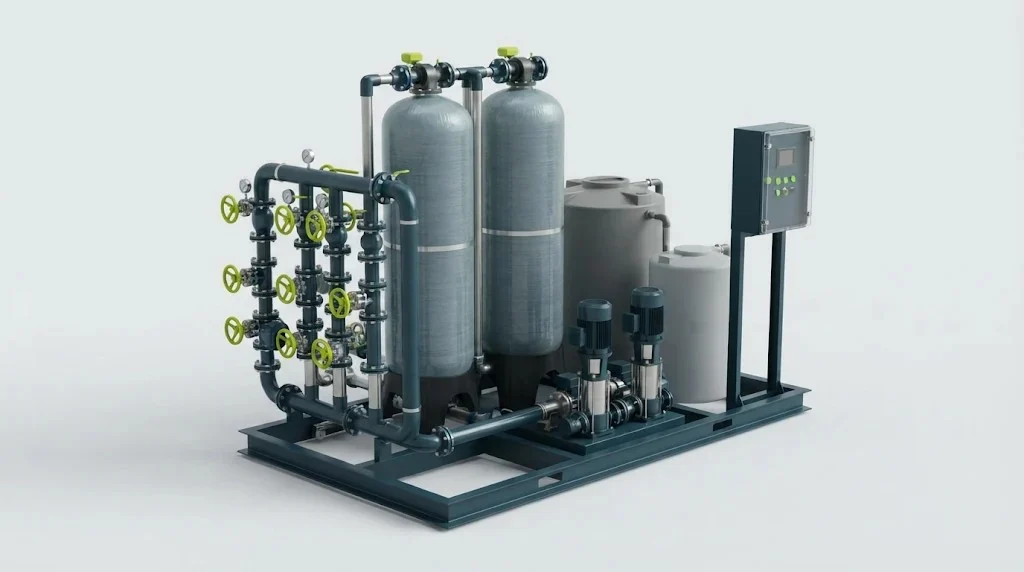
The water passes through a bed of resin beads with charged functional groups. Dissolved ions (calcium, magnesium, sulfates, nitrates, metals) attach to the resin, which releases sodium, hydrogen, hydroxide or chloride in exchange. The reaction is reversible: the exhausted resin is regenerated with salt, acid or caustic soda and goes back into service.

Other technologies
Ion exchange resins – plant diagram

Bead size

0.5–1 mm

Resin types

6 groups

Regeneration

Salt, acid or caustic soda

Nitrates

> 90% removal

Operating principle

How it works

  1. 01

    Service

    The water flows through the active resin until its exchange capacity is exhausted.

  2. 02

    Backwash

    Depending on the design, a reverse flow loosens the bed and carries away the retained solids.

  3. 03

    Regeneration

    Salt in softeners, strong acid for H-form cation resin and caustic soda for OH-form anion resin.

  4. 04

    Slow and fast rinse

    Removes excess regenerant before the unit goes back into service.

Specifications

Technical data

Bead size0.5–1 mm
RegenerantsNaCl; HCl or H₂SO₄; NaOH, depending on the column
ConfigurationsSoftener; cation + anion; weak before strong; mixed bed for polishing; polishing after reverse osmosis or with EDI
PretreatmentFiltration, dechlorination and removal of organic compounds to protect the resin
Sizing dataFull water analysis (cations, anions, TDS, pH, alkalinity, silica, oxidants), target quality, service flow rate and available regenerants
SizingService flow rate, resin volume, regeneration frequency and pretreatment
Signs of exhaustionHardness leakage after the softener; rising conductivity or silica after demineralization
MaintenanceA high pressure drop calls for backwashing; if performance falls, check regeneration, oxidation and organic fouling
Chelating resinsSpecific ligands (iminodiacetic, thiol, amidoxime) retain particular metals even at trace levels and allow them to be recovered
Other adsorbentsZeolite for ammonium and metals; activated alumina for fluorides and arsenic
Indicative footprint1–1.5 m² per m³/h; skid-mounted

Resin types

TypeWhat it retainsTypical use
Strong acid cation (SAC)Ca²⁺, Mg²⁺, Na⁺, Fe²⁺, over a wide pH rangeSoftening (Na form) and demineralization (H form)
Weak acid cation (WAC)Carbonate hardnessAhead of the SAC in highly alkaline water; saves regenerant
Strong base anion (SBA)Strong and weak anions, including silicaFull demineralization, very low conductivity
Weak base anion (WBA)Free mineral and organic acidsAhead of the SBA; saves caustic and protects against organic compounds
Mixed bedResidual cations and anionsFinal polishing after reverse osmosis or two-bed demineralization
Selective and chelatingHeavy metals, arsenic, boron, nitratesWastewater with toxic metals; nitrates in drinking water

Advantages

  • High efficiency against specific ions
  • Compact units, easy to automate
  • The resin can be regenerated for many cycles
  • Combined with reverse osmosis or EDI, it produces ultrapure water

Field of application

  • Softening ahead of boilers, heat exchangers or reverse osmosis
  • Demineralization for pharmaceuticals, food, electronics and high-pressure boilers
  • Polishing after reverse osmosis
  • Removal of nitrates, heavy metals, arsenic or boron
  • Low-salinity industrial wastewater

Limitations

  • Highly saline water needs a lot of resin and a lot of regenerant
  • Sensitive to free chlorine, temperature and organic compounds
  • Regeneration produces brine or acid and alkaline effluents that have to be managed

Industries

Where it is used

Boilers and energyPharmaceuticalsFood and beverageElectronicsSurface treatmentDrinking water

Datasheet

Full datasheet: Ion exchange resins

Dimensions, design data and operating ranges. Leave us your details and an engineer will send you the datasheet and tell you whether this technology fits your plant.

All technologies

Datasheet

Request the full datasheet

Choose the technology and leave us your details. An engineer who knows that technology will send you the datasheet.

  • Full technical data for the technology you choose
  • An assessment of whether it suits your gas or your effluent

Would you rather write to us directly?

info@wizzum.com

The first conversation is free and with no obligation.