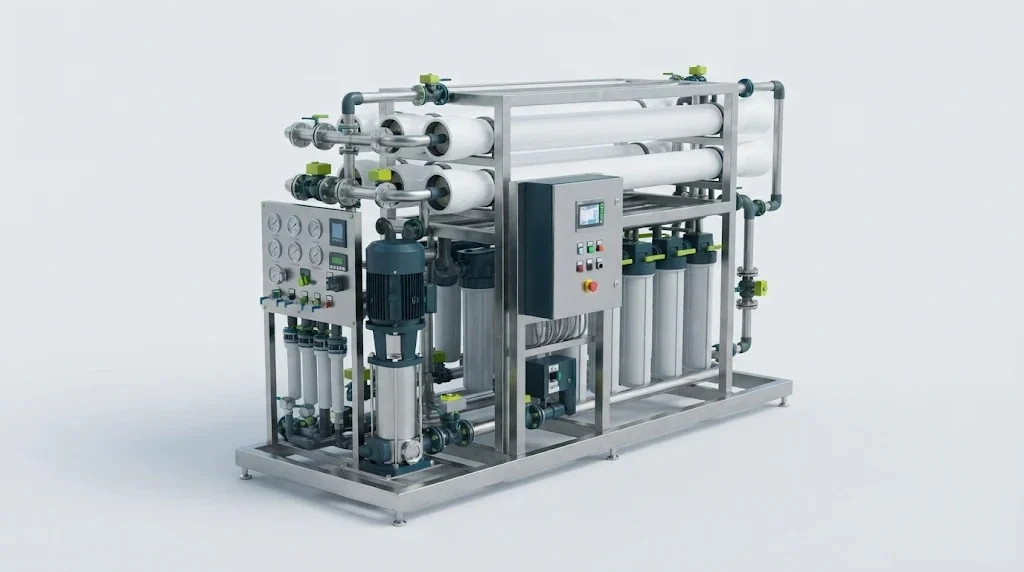
| Reference installations | 250 m³/day nanofiltration for the chemical industry; 180 m³/day reverse osmosis; containerized osmosis plants of 300 and 1,000 m³/day |
| Compact build | Also available as a compact skid-mounted or containerized plant, factory-tested |
| Microfiltration (MF) | 0.1–10 µm · bacteria, turbidity, macromolecules, colloids |
| Ultrafiltration (UF) | 0.001–0.1 µm · viruses, macroproteins, antibiotics |
| Nanofiltration (NF) | 0.1 nm–0.001 µm · softening, heavy metals, nitrates, color |
| Reverse osmosis (RO) | Salts, organic compounds, acids, microorganisms; permeate with 1–5% of the inlet salt |
| RO pressure | 5–10 bar ultrapure water · 10–20 bar nitrates and organic compounds · 20–40 bar concentration · 50–80 bar seawater |
| Membrane material | Polyamide (previously cellulose acetate) |
| Desalination capacity | 1–1,000 m³/day; brackish water of 1,000–10,000 mg/l |
| Chemical cleaning | Acid with EDTA for scaling; alkaline with surfactants for organic compounds; chlorine for microorganisms |
| Operating pressures by type | MF 0.5–2 bar · UF 2–6 bar · NF 4–30 bar · RO 5–80 bar (up to 120 bar for high pressure) |
| High-pressure osmosis | To minimize brines: 60–90 bar, and up to 100–120 bar for ultra-high pressure |
| Power consumption | Brackish water RO 0.6–2.5 kWh/m³; seawater 3–6 kWh/m³; ultra-high pressure 8–12 kWh/m³ |
| Configurations | Spiral wound (the most compact, NF and RO), capillary (UF and MBR), flat sheet, tubular (heavily loaded liquids) and ceramic (high temperature and extreme pH) |
| Materials | Polymeric (PES, PVDF, polyamide, PAN, PTFE) or ceramic |
| Antiscalant | 1–5 mg/l in the NF and RO feed |
| Service life | RO and NF membranes 1–3 years; UF and MF 5–7 years |
| Indicative footprint | 1.5–3 m² per m³/h; indoor, skid-mounted or containerized installation |
| Electrodialysis | An alternative with ion exchange membranes: 70–90% recovery and lower consumption than RO at low salinity |