Home / Technologies / Odors / Oxidizing scrubber

OxidizesOdors

Oxidizing scrubber

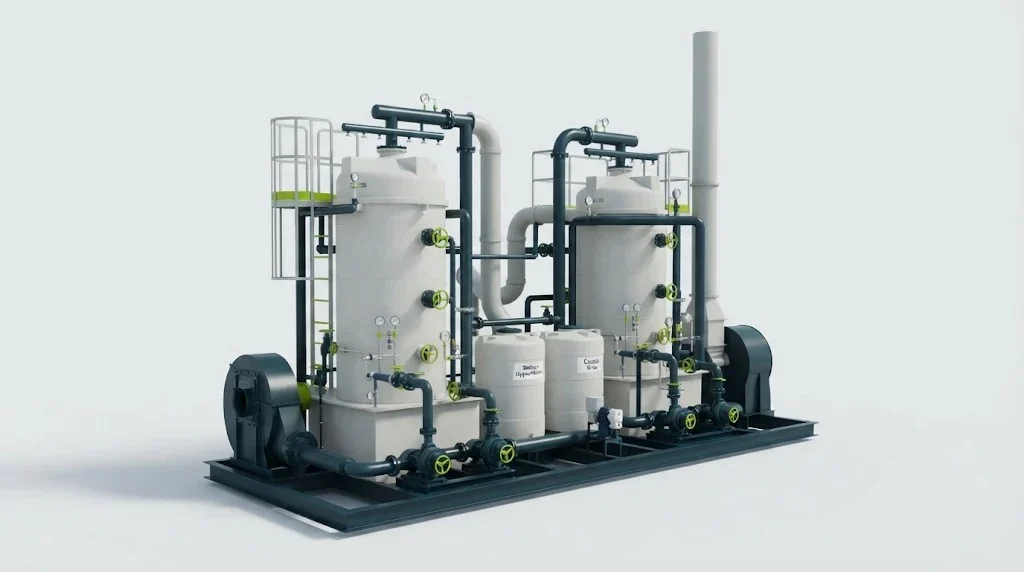
The volatile compounds transfer to the scrubbing water, where they are chemically oxidized with hypochlorite or peroxide. With ozone, oxidation takes place in the gas phase ahead of the scrubber, which captures the partially oxidized compounds.

Other technologies
Oxidizing scrubber – plant diagram

Efficiency

> 99% (H₂S, dimethyl sulfide)

Usual oxidant

Sodium hypochlorite

Control

Redox potential, pH and conductivity

Pre-stage

Acid scrubbing if NH₃ or amines are present

Operating principle

How it works

  1. 01

    Acid pre-scrubbing

    Removes NH₃ and amines so that toxic chloramines do not form.

  2. 02

    Absorption

    The odorous compounds transfer to the scrubbing water.

  3. 03

    Oxidation

    The oxidant converts them into less harmful substances; with ozone, oxidation takes place in the gas phase ahead of the scrubber.

  4. 04

    Control

    Redox and pH control the dosing; the solution is renewed based on conductivity.

Specifications

Technical data

Sulfur compoundsH₂S, dimethyl sulfide (DMS), dimethyl disulfide (DMDS)
OthersFormaldehyde, NOx, acrylates, acetates, aldehydes, organic and inorganic acids
OxidantsSodium hypochlorite (the most common: strong oxidizing power and easy to source), hydrogen peroxide; ozone in the gas phase
Automatic controlRedox potential (ORP) and pH of the scrubbing water
Role of pHImproves kinetics, reduces reagent consumption, prevents scaling and limits the release of unwanted compounds
Solution renewalBased on conductivity
Efficiency> 99% for H₂S and dimethyl sulfide under optimal conditions
Multi-stage systemOxidizing scrubber followed by a dry polishing filter, for DMDS for example
Flow rate1,000–60,000 m³/h per tower
Installed power2.5–95 kW depending on the flow rate (packed tower range)

Advantages

  • Very high efficiency on sulfur compounds
  • Converts volatile compounds into less harmful substances
  • Easy-to-source reagent
  • Automatic control of redox, pH and conductivity

Field of application

  • Bio-industry odors (H₂S, DMS, DMDS)
  • Formaldehyde and NOx
  • Acrylate, acetate and aldehyde vapors

Limitations

  • NH₃ and amines have to be removed first (risk of chloramines)
  • Reagent consumption, scaling and emissions are controlled through pH
  • Ozone needs a gas-phase oxidation pre-stage

Industries

Where it is used

Bio-industryWastewater treatment plantsChemicalsStorage terminalsFood

Datasheet

Full datasheet: Oxidizing scrubber

Dimensions, design data and operating ranges. Leave us your details and an engineer will send you the datasheet and tell you whether this technology fits your plant.

All technologies

Datasheet

Request the full datasheet

Choose the technology and leave us your details. An engineer who knows that technology will send you the datasheet.

  • Full technical data for the technology you choose
  • An assessment of whether it suits your gas or your effluent

Would you rather write to us directly?

info@wizzum.com

The first conversation is free and with no obligation.