Home / Technologies / VOCs and solvents / Activated carbon

RecoversVOCs and solvents

Activated carbon adsorption

Adsorption without destroying the pollutants: they stay on the surface of the carbon. If the carbon is regenerated with steam or inert gas, the solvent can be recovered and reused.

Other technologies
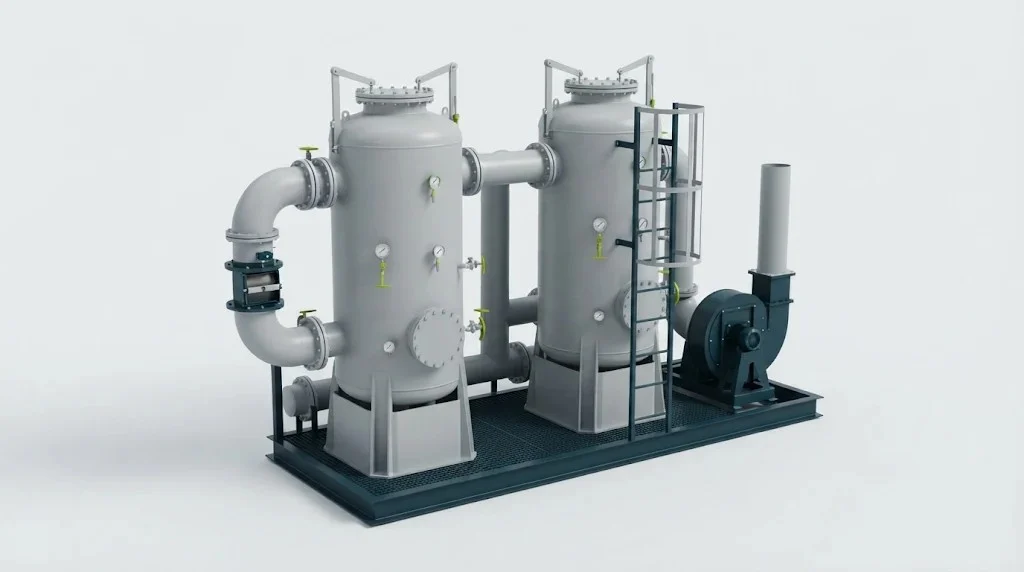
Activated carbon adsorption – plant diagram

Concentration

Low

Solvent recovery

Yes, with regeneration

Pressure drop

Very low

Flow rate

1,000–100,000 Nm³/h

Operating principle

How it works

  1. 01

    Passage through the bed

    The gas passes through the carbon bed and the pollutants attach to the granules.

  2. 02

    Saturation monitoring

    Load cells continuously measure the weight gain of the carbon.

  3. 03

    Regeneration or replacement

    The saturated carbon is replaced and thermally reactivated, or regenerated on site with steam or inert gas.

  4. 04

    Recovery

    With on-site regeneration, the solvent goes back to the process.

Specifications

Technical data

Operating principleAdsorption without destroying the pollutants
PollutantsVOCs, hydrocarbons, solvents, aromatics, odors, SO₂, NO₂, Cl₂, H₂S, siloxanes, chlorinated compounds, dioxins
Suitable concentrationLow
Design factorsType and concentration of the pollutant, humidity, temperature, flow rate, contact time and carbon grain size
Flow directionLongitudinal (small and medium flow rates) or crossflow (large flow rates)
ColumnStainless steel; 5-way selector valve, manual or automatic
RegenerationThermal reactivation, steam or inert gas
MonitoringLoad cells that track saturation
Pressure dropVery low; an additional fan is often not needed
Design life30 years
Air flow rate1,000–100,000 Nm³/h; several adsorbers in parallel
Efficiency90–99% depending on the compound and contact time
Gas conditionsBelow 40–50 °C and with relative humidity under 50–60%

Advantages

  • Very effective at capturing solvents and chemicals
  • Relatively low investment
  • Fully automatic operation
  • Full use of the carbon thanks to saturation monitoring
  • Very low pressure drop
  • Design adapted to seismic zones and climate

Field of application

  • Low pollutant concentrations
  • Pollutants that are not water-soluble
  • Deodorization of industrial processes
  • Final polishing or solvent recovery

Limitations

  • Saturated carbon has to be replaced or regenerated
  • Of little use at high concentrations

Industries

Where it is used

Wastewater treatment plantsFood (slaughterhouses, animal fats, fish)Chemicals and pharmaceuticalsCosmeticsBiogasSolar thermal power plantsWaste management

Datasheet

Full datasheet: Activated carbon

Dimensions, design data and operating ranges. Leave us your details and an engineer will send you the datasheet and tell you whether this technology fits your plant.

All technologies

Datasheet

Request the full datasheet

Choose the technology and leave us your details. An engineer who knows that technology will send you the datasheet.

  • Full technical data for the technology you choose
  • An assessment of whether it suits your gas or your effluent

Would you rather write to us directly?

info@wizzum.com

The first conversation is free and with no obligation.