Home / Technologies / Compact plants / Desalination plant

DesalinatesCompact plants

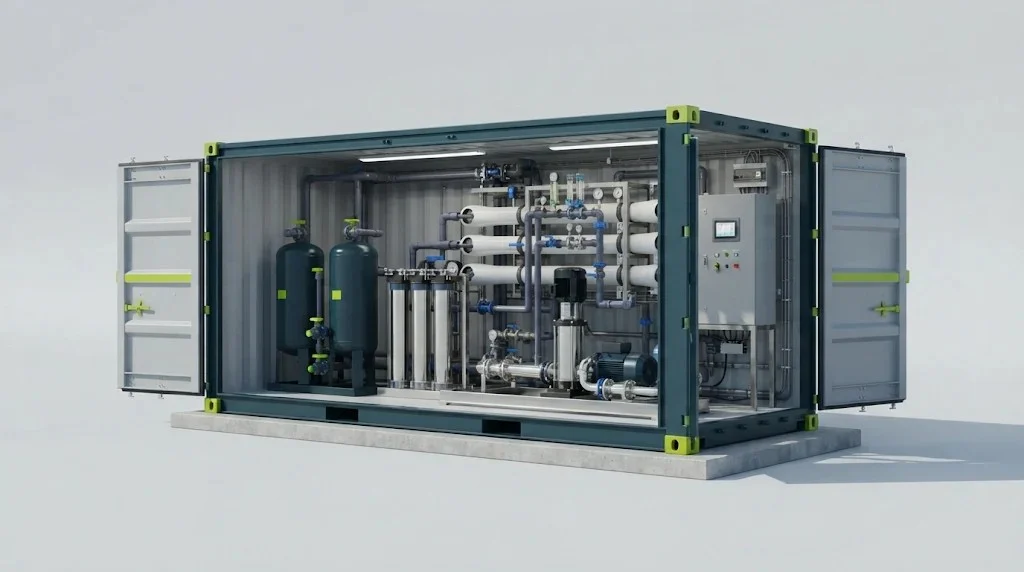
Compact desalination plant

A reverse osmosis plant with energy recovery that turns seawater or brackish water into water for drinking, irrigation or street washing, depending on the post-treatment.

Other technologies
Compact desalination plant – plant diagram

Capacity

20–2,500 m³/day

Recovery

45 %

Specific consumption

2.25 kWh/m³ with energy recovery

Osmosis pressure

60–70 bar (seawater)

Operating principle

How it works

  1. 01

    Pretreatment

    Multimedia filtration, chemical dosing and cartridge filters, depending on the water analysis.

  2. 02

    Reverse osmosis

    A pump drives the water through the membranes, producing product water and brine.

  3. 03

    CIP cleaning

    Clean-in-place system for the membranes.

  4. 04

    Post-treatment

    Chemical dosing according to the use; for drinking water, disinfection and quality control.

Specifications

Technical data

Raw waterSeawater or brackish water
PretreatmentMultimedia filtration, chemical dosing and cartridge filters
ProcessReverse osmosis producing product water and brine
Capacity20–2,500 m³/day of product water; modular expansion
Recovery45 %
EnergyEnergy recovery calculated for seawater; specific consumption depends on salinity, temperature, flow rate and recovery
Brackish waterLower pressure and salinity: higher recovery and lower consumption
Product qualityTo be defined; drinking water requires post-treatment, disinfection and a specific monitoring regime
OperationAutomatic, with remote monitoring and configurable alarms
50 m³/day example · raw waterSeawater, salinity < 35,000 ppm; 112 m³/day feed for 50 m³/day of product
Design rangeWater temperature 5–45 °C; osmosis operating pressure 60–70 bar
Pretreatment (example)1 multimedia filter with automatic backwash and 2 microfilters with 5 µm cartridges
Reverse osmosis (example)1 pressure vessel with 4 eight-inch membranes; high-pressure pump with energy recovery
Post-treatment (example)Remineralization and chlorination
Specific consumption2.25 kWh/m³ with energy recovery (50 m³/day example)
MaterialsLow pressure in PVC and HDPE; high pressure and pump in 2205 duplex steel; AISI 304 stainless steel frame
ExecutionSkid-mounted or in a 20 or 40 ft container; fast plug & play installation and connection, mobile and relocatable
TestingFactory assembly and integration of equipment, piping, instrumentation and controls; FAT before shipping
SiteAllow for maintenance access, connections, reagent storage and brine management

Reference configurations

OutputExecutionDimensions L × W × HEmpty weight
50 m³/daySkid5.60 × 1.90 × 2.10 m1,655 kg
50 m³/day20 ft container6.06 × 2.44 × 2.59 m4,655 kg
300 m³/dayContainerOn requestOn request
1,000 m³/dayContainer with drop-down sideOn requestOn request

Advantages

  • Product water suited to its use
  • Automatic operation with remote monitoring
  • Factory-tested and ready to connect
  • Modular expansion

Field of application

  • Drinking water where freshwater is scarce
  • Water for irrigation and street washing

Limitations

  • Produces brine that has to be managed
  • Energy use depends on salinity and recovery

Industries

Where it is used

Hotels and resortsCampsitesMarinasGolf coursesMunicipalities

Datasheet

Full datasheet: Desalination plant

Dimensions, design data and operating ranges. Leave us your details and an engineer will send you the datasheet and tell you whether this technology fits your plant.

All technologies

Datasheet

Request the full datasheet

Choose the technology and leave us your details. An engineer who knows that technology will send you the datasheet.

  • Full technical data for the technology you choose
  • An assessment of whether it suits your gas or your effluent

Would you rather write to us directly?

info@wizzum.com

The first conversation is free and with no obligation.