Home / Technologies / Water and discharge / Vacuum evaporation

ConcentratesWater and discharge

Vacuum evaporation

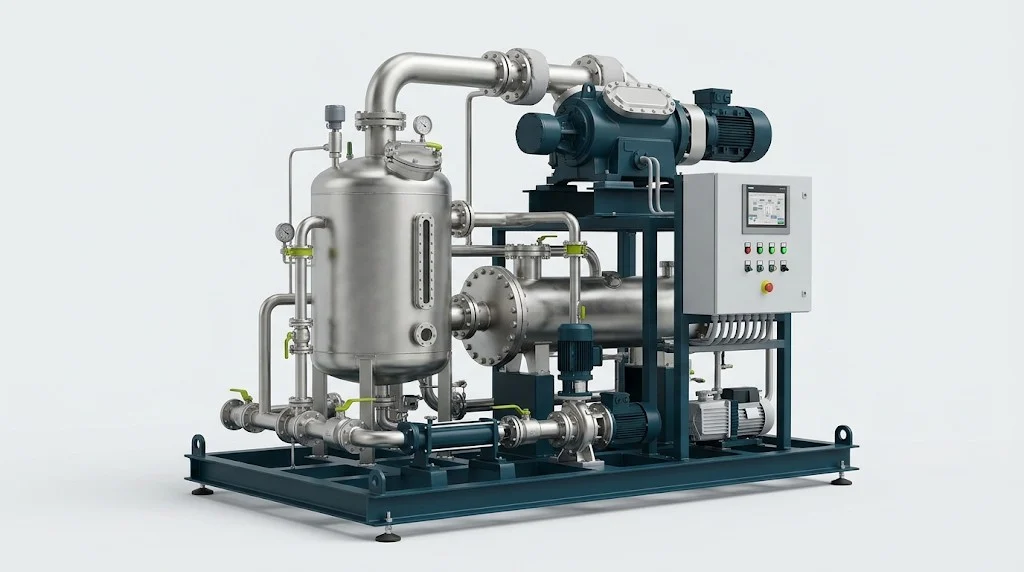
Thermally separates wastewater, at reduced pressure, into a clean distillate and a concentrate or dry residue. It is the basis of zero liquid discharge, water recovery and raw material recovery systems.

Other technologies
Vacuum evaporation – plant diagram

Capacity

10–10,000 l/h

Water recovery

Up to 99%

Power consumption

30–170 kWh/m³

Heat consumption

230–700 kWh thermal/m³

Operating principle

How it works

  1. 01

    Food

    The wastewater enters the evaporation chamber after being preheated with the distillate.

  2. 02

    Vacuum evaporation

    The vacuum lowers the boiling point; the water evaporates at 35–90 °C depending on the technology.

  3. 03

    Condensation

    The vapor condenses as clean distillate; in electric units its latent heat is reused.

  4. 04

    Concentrate discharge

    The pollutants stay in the concentrate, which is discharged automatically.

Range

The evaporator range

Seven vacuum evaporation technologies that differ in energy source, heat exchanger and capacity. The choice depends on the volume of wastewater, its composition and the heat available at the plant.

Electric · vapor recompression (MVR)

Falling film

Capacity
30–2,500 l/h
Consumption
30–90 kWh/m³
Temp. · vacuum
Around 90 °C · 700 mbar

Foaming water, emulsions, rinse water; CIP cleaning

Technical details →

Electric · vapor recompression (MVR)

Forced circulation

Capacity
1,042–4,166 l/h
Consumption
35 kWh/m³
Temp. · vacuum
90–94 °C · 750 mbar

Large volumes with a light load; limits scaling

Technical details →

Electric · vapor recompression (MVR)

Natural circulation

Capacity
120–3,850 l/h
Consumption
30–90 kWh/m³
Temp. · vacuum
Around 90 °C · 700–750 mbar

Emulsions and oily water; no recirculation pump

Information on request

Thermal · multiple effect

Forced circulation

Capacity
15,000–200,000 l/day
Consumption
315–4,085 kWth + 20–110 kW
Temp. · vacuum
70–50 °C · 310–125 mbar

Large volumes with waste heat available

Technical details →

Specifications

Technical data

Compact buildAlso available as a compact skid-mounted or containerized plant, factory-tested
Capacity rangeHeat pump (HP) 10–2,200 l/h · mechanical vapor recompression (MVR) 30–4,166 l/h · thermal 10–10,000 l/h
Heat pump (HP) consumption150–170 kWh/m³ (single effect) · 110 kWh/m³ (double effect)
Mechanical recompression consumption30–90 kWh/m³; decreases as unit size increases
Heat consumption700 kWh thermal/m³ (single effect) · 350 (double effect) · 230 (triple effect)
Multiple effect in practiceWith the same thermal power (around 436 kWth), one effect evaporates about 15 m³/day, two effects 30 and three effects 45
Heat sources (thermal units)Hot water, steam or thermal oil
Refrigerant (heat pump)R-407C or R-134A, with a secondary vacuum circuit
Condensation in thermal unitsPlate heat exchanger with cooling water, or an air/water dry cooler with the same capacity as the evaporation
Temperature and vacuumHeat pump (HP) 35–50 °C · 60–125 mbar; recompression around 90 °C · 700–750 mbar; multiple effect 70 / 60 / 50 °C · 310 / 200 / 125 mbar
Heat exchangersSubmerged coil, shell and tube, plate or submerged tube bundle
Mist eliminatorRaschig rings, mesh demister or cyclone separator
Vacuum systemVenturi ejector, liquid ring pump or Roots blower
MaterialsAISI 316 / 316L (316Ti in falling film evaporators); super duplex 2507 or titanium if chlorides and fluorides are present; PVDF-lined chamber and graphite or nickel alloy heat exchanger for very aggressive liquids (chromic acid)
AutomationFoam control with a sensor and antifoam dosing; concentrate discharge by density meter or timer; automatic internal washing with a rotating head; optional remote monitoring
Droplet separation in falling film evaporatorsMulti-stage centrifugal separator ahead of the vacuum pump
Control and power supplyPLC with HMI touchscreen · IP54–IP55 · 400 V III + PE 50 Hz · 24 h automatic operation
Acceptable feedHigh salinity (TDS), toxic substances, acids, metals, refractory COD, heavily scaling concentrates
Data basisClean water distillate at 20 °C and 1013 mbar
Industry reference rangesMechanical recompression 20–80 kWh/m³; heat pump 100–200 kWh/m³; multiple effect 210–600 kWh thermal/m³ plus 12–25 kWh/m³ for pumping
Compressor in mechanical recompressionRoots blower in small and medium units (up to around 3,000 kg/h of vapor), more tolerant of wet vapor; turbocompressor for large flows (up to around 50,000 kg/h), more efficient
Temperature difference in mechanical recompression3–6 °C across the heat exchanger, which calls for large surfaces
AdditivesAntifoam and antiscalant, 5–100 mg/l depending on the wastewater
Heat exchanger life15–25 years with periodic CIP cleaning
Indicative footprint3–5 m² per m³/h; indoor installation recommended
Civil worksOnly 10–20% of the total; the rest is equipment

Evaporator range comparison

TechnologyEnergyCapacityConsumptionTemperature · vacuumApplication
Heat pump (HP) · single effect, submerged heat exchangerElectric250–20,000 l/day150–170 kWh/m³Around 35 °C · around 60 mbarAqueous solutions with a light load; compact unit with removable chambers
Heat pump (HP) · double effect, forced circulationElectric6,720–52,800 l/day110 kWh/m³50 / 40 °C · 125 / 70 mbarLarger volumes; water with a slightly higher scaling tendency
Mechanical recompression (MVR) · falling filmElectric30–2,500 l/h30–90 kWh/m³Around 90 °C · around 700 mbarFoaming water, emulsions, surface treatment rinse water; CIP cleaning
Mechanical recompression (MVR) · forced circulationElectric1,042–4,166 l/h35 kWh/m³90–94 °C · around 750 mbarLarge volumes with a light load; limits scaling
Mechanical recompression (MVR) · natural circulationElectric120–3,850 l/h30–90 kWh/m³Around 90 °C · 700–750 mbarEmulsions and oily water; no recirculation pump
Thermal · submerged tube bundle, 1–3 effectsHot water, steam or thermal oil4,000–30,000 l/day4–12 kW + 130–315 kWth70 / 60 / 50 °C · 310 / 200 / 125 mbarModerate volumes; expandable from 1 to 3 modules
Thermal · forced circulation, 1–3 effectsHot water or steam15,000–200,000 l/day20–110 kW + 315–4,085 kWth70 / 60 / 50 °C · 310 / 200 / 125 mbarLarge volumes with waste heat available

Advantages

  • Up to 99% of the water recovered for the process, cleaning or irrigation
  • Less waste to hand over to an external waste manager
  • Recovery of raw materials and by-products
  • Mechanical recompression (MVR): the lowest power consumption per m³
  • Heat pump (HP): no boilers or steam; the low temperature protects heat-sensitive products and materials
  • Multiple effect: each additional effect reuses latent heat and cuts heat consumption
  • Modular design, expandable without a large increase in consumption

Field of application

  • Zero liquid discharge (ZLD) and water reuse
  • Oil emulsions and metalworking fluids, die-casting release agents and glycols, spent baths and electroplating eluates (Cr, Ni, Cu), vibratory finishing
  • Foaming water, surface treatment rinse water, penetrant liquids, chemical and pharmaceutical reactor washing
  • Reverse osmosis reject, leachate, brines, water containing surfactants
  • Recovery of fertilizers, acids, salts, precious metals, paints and pigments, proteins and solvents

Limitations

  • Capacities and consumption figures are for clean water; they depend on composition and final concentration
  • Multiple effect requires more investment and space, and only pays off if the plant has cheap heat
  • Thermal units need cooling water

Industries

Where it is used

EnergyAutomotiveFoodMetal treatment and electroplatingChemicals and pharmaceuticalsWaste and battery recyclingBuilding materialsBiogas

Datasheet

Full datasheet: Vacuum evaporation

Dimensions, design data and operating ranges. Leave us your details and an engineer will send you the datasheet and tell you whether this technology fits your plant.

All technologies

Datasheet

Request the full datasheet

Choose the technology and leave us your details. An engineer who knows that technology will send you the datasheet.

  • Full technical data for the technology you choose
  • An assessment of whether it suits your gas or your effluent

Would you rather write to us directly?

info@wizzum.com

The first conversation is free and with no obligation.