
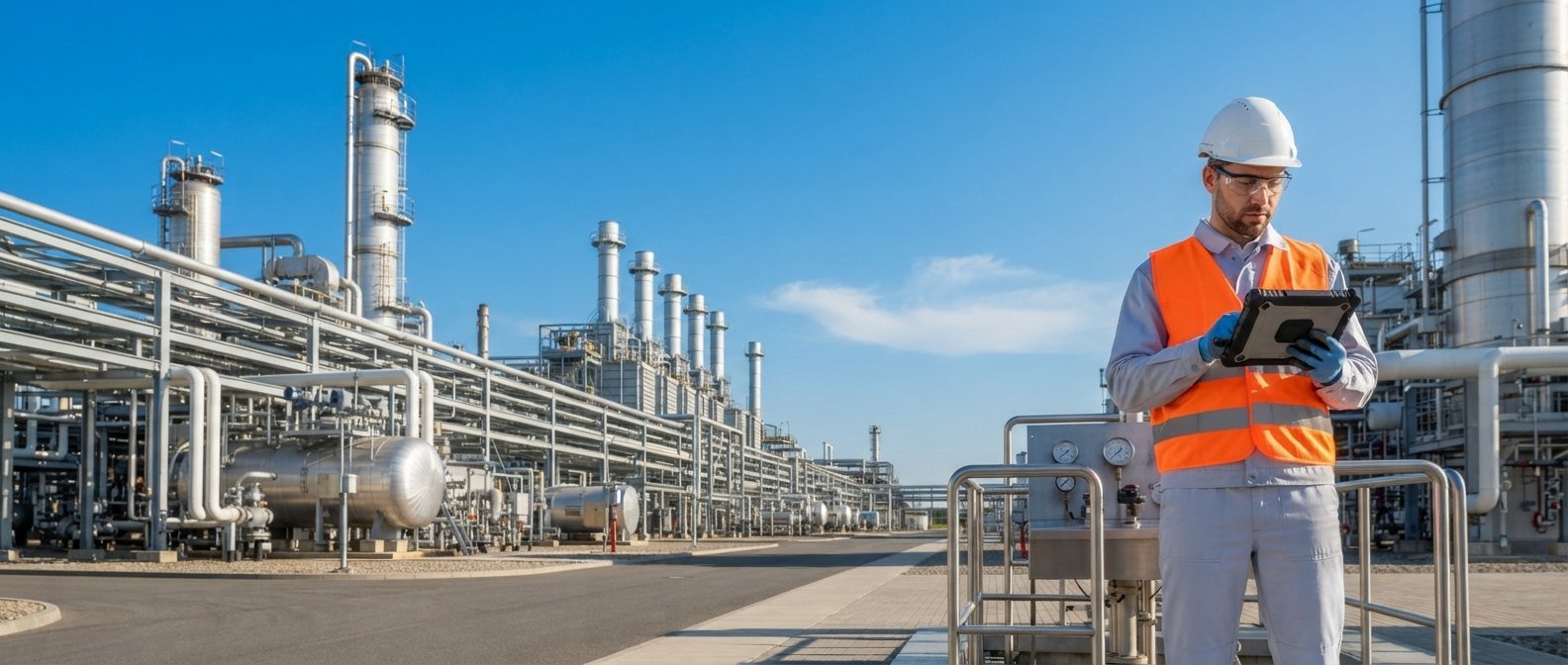
Refinery at dusk with distillation columns and spherical tanks

Home / Industries / Energy, refining and petrochemicals

06

Energy, refining and petrochemicals

Engine and turbine power plants, cogeneration, refineries, storage terminals and petrochemical plants. Large installations with strict limits, where water quality is a condition for producing at all.

Engine power plantsCogenerationRefiningStorage terminalsPetrochemicals

Where the problem starts

ProcessReleases to airDischarges to water
Combustion in engines, turbines and boilersNOx, SO₂, particles and COBoiler blowdown
CoolingPlume and aerosolsBlowdown with salts and biocides
Make-up water treatmentNo significant emissionRO reject and resin regeneration
Fuel storage and loadingVOCs and methaneOily water and contaminated stormwater
Process unitsH₂S, mercaptans and VOCsSour water, spent caustic and phenols

Industry challenges

Emission challenges

5
  1. 1NOx, SO₂ and particles from combustion, with limits that depend on the fuel and the rated power.
  2. 2Heavy fuel oil: sulphur and ash that call for several treatment stages combined.
  3. 3VOCs and methane from tanks, loading bays and process vents.
  4. 4H₂S and mercaptans, with odour noticeable outside the plant.
  5. 5Intake air quality for turbines and engines, which affects output and availability.

Water challenges

5
  1. 1Demineralised water for boilers and the steam cycle: poor quality is paid for in scaling and corrosion.
  2. 2Cooling tower blowdown with salts and biocides.
  3. 3Oily water with hydrocarbons and phenols.
  4. 4Desalination and containerised plants for coastal or remote sites.
  5. 5Effluent from flue gas scrubbing itself, which moves the problem from air to water if it is not planned for.

Regulatory framework

BREF for large combustion plants and refining BREF. For medium combustion plants, Spain’s Royal Decree 1042/2017.

Common technologies

Selective catalytic NOx reductionDesulphurisationVapour recoveryActivated carbonOil-water separatorsReverse osmosisElectrodeionisation
5.5 m³/hof FGD purge with no discharge

Reference case · Power station (Condorchem)

Coal-fired power station in Asturias, with the purge from the flue gas desulphurisation scrubber loaded with salts and metals. It is treated with filtration, a physical-chemical stage and a vacuum evaporator-crystalliser built in corrosion-resistant material. Result: zero liquid discharge.

Read the case study

InputFGD purge with salts and metals
StageFiltration
StagePhysical-chemical
StageVacuum evaporator-crystalliser
ResultZero liquid discharge

Facing a similar problem at your plant?

Tell us what you emit or discharge and which limit you have to meet. The first conversation is free of charge.

Tell us about your case

Environmental engineering for industry.
Industrial wastewater, emissions and odors.

OFFICE

Avda. Cabrera, 36
08302 Mataró (Barcelona), Spain
info@wizzum.com

© 2026 Wizzum. All rights reserved.